Rec Center
There's a Climbing Wall in the Rec Center Plan. Here's Why.
TL;DR:
The proposed Twin Falls recreation center includes a climbing wall as part of its youth programming. Climbing has been an Olympic sport since 2020. It builds strength, problem-solving, and confidence in ways no court sport can replicate. At a recreation center, a climbing wall serves as a drop-in activity for after-school hours, a rotation station during summer camps, a birthday party add-on, a team-building venue for scout troops and corporate groups, and the one feature in the building that makes a 9-year-old drag their parents through the front door. It is not the centerpiece of the facility. It is the thing that makes the facility unforgettable for kids.
The proposed Twin Falls recreation center lists its major features in the order you would expect: four regulation basketball courts, volleyball courts, dedicated pickleball courts, an indoor track, fitness center, exercise studios, multipurpose rooms, senior wellness area.
Tucked into that list, grouped under youth programming, is a climbing wall.
It does not get top billing. It is not the reason the facility will be built. But ask any parent whose kid has been inside a recreation center that has one, and they will tell you the same thing: the climbing wall is the reason their child asks to go back.
Not the backyard rope climb
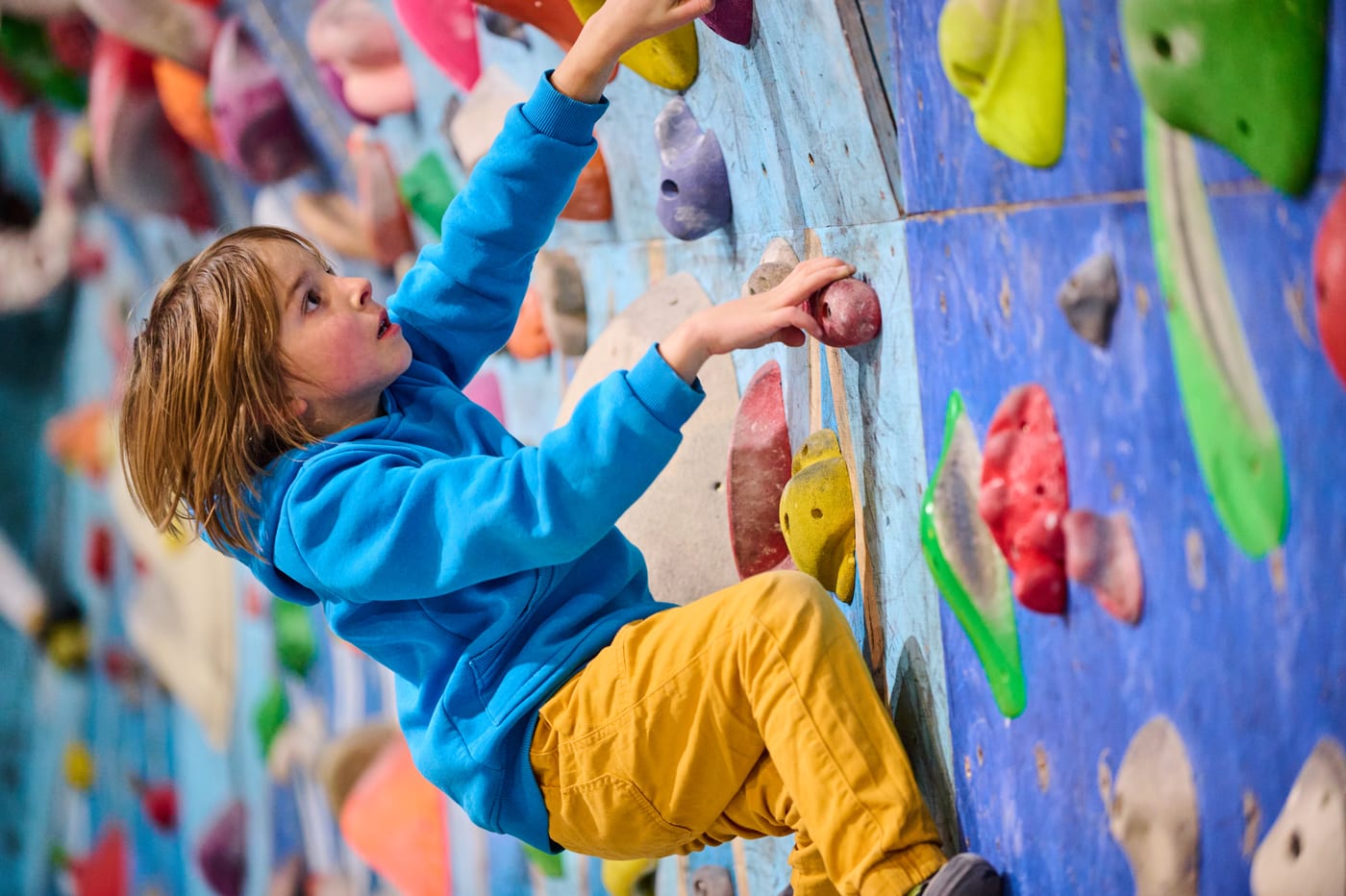
When most people hear "climbing wall," they picture a flat panel with colored handholds bolted to a gymnasium wall. That version exists, and it is fine for what it is. But a recreation center climbing wall is typically more than that.
A well-designed rec center climbing wall features multiple routes at varying difficulty levels, from beginner-friendly paths that a 5-year-old can complete on the first try to challenging overhangs that keep a teenager coming back for weeks trying to finish. Auto-belay systems allow climbers to ascend and descend safely without a partner holding a rope. Bouldering sections (shorter walls with thick crash pads underneath) let kids climb without harnesses at all.
Climbing became an Olympic sport at the 2020 Tokyo Games and returned at Paris 2024, bringing the sport into mainstream visibility. Youth climbing participation has surged globally as a result. But at the recreation center level, the Olympic connection matters less than the practical one: climbing is the activity that reaches kids who do not connect with ball sports, court sports, or team athletics.
The kid who does not like team sports
Every blog in the tournament series described sports that work in teams: basketball (five per side), volleyball (six per side), futsal (five per side), dodgeball (six to eight per side). The martial arts blog was the first to address individual-discipline athletics.
Climbing is something different again. It is not individual versus an opponent. It is individual versus a wall. There is no score. There is no clock. There is no team counting on you to perform. There is a route, a set of holds, and the question of whether you can figure out how to get to the top.
For kids who thrive on problem-solving rather than competition, who prefer physical challenges they can attempt at their own pace rather than games where mistakes cost the team a point, climbing is the activity that finally fits. These kids exist in every community. They are the ones who sit out during basketball drills, drift to the edges during volleyball games, and come alive when the challenge is between them and something they can solve with their hands, feet, and brain.
A recreation center without a climbing wall has nothing for this kid. A recreation center with one has the activity that might become the most important part of their week.
What a climbing wall does on a daily basis
The climbing wall is not a standalone facility that needs its own building or its own schedule. It is an activity station built into the rec center's existing flow, generating traffic and revenue across multiple programming categories.
After-school drop-in. The 3-to-6 window is when the climbing wall sees its heaviest youth traffic. Kids who walk in after school can rotate between open gym basketball, the climbing wall, and the table tennis tables in the multipurpose room. The wall gives them a physical challenge that is different from anything on the courts and keeps them engaged for longer visits.
Summer camp rotations. During break-week programming, camp groups rotate through the climbing wall as one of several activity stations throughout the day. A group of twelve kids can cycle through the wall in 30 to 45 minutes, with each child getting multiple climbs. It is one of the most consistently popular camp activities at every rec center that offers it.
Birthday parties. A 90-minute birthday party package that includes 45 minutes on the climbing wall and 45 minutes in a multipurpose room for pizza and cake is one of the simplest, most popular rental offerings a recreation center can provide. The wall does the entertaining. The room does the celebrating. The facility collects the rental fee. Parents who have hosted a climbing wall birthday party at a rec center in Boise or Nampa know exactly how this works. Twin Falls parents currently drive to those cities to access it.
Youth climbing clinics. Multi-week sessions, typically four to six weeks, teaching climbing technique, route reading, and safety skills. These run as regular rec center programming alongside martial arts, cheerleading, and other youth classes. Session fees generate program revenue.
Scout troops and team-building groups. Boy Scout and Girl Scout troops, church youth groups, school field trips, and corporate team-building events book supervised climbing sessions as group activities. These are facility rentals that fill daytime and weekend slots when the wall might otherwise be idle.
Open climb for all ages. During open recreation hours, the climbing wall is available to any member. Adults use it for fitness. Teenagers use it for challenge. Families use it together, with a parent belaying while a child climbs or a parent and child both bouldering side by side.
What climbing builds that other sports do not
Every sport in the rec center builds physical fitness. Climbing builds something additional that is harder to name but easy to observe.
Problem-solving under pressure. A climbing route is a puzzle. Each hold requires the climber to assess their position, plan two moves ahead, and decide where to commit their weight. This is cognitive work happening simultaneously with physical effort. For children, this combination of thinking and moving develops executive function skills that research links to academic performance and emotional regulation.
Controlled risk-taking. A child on a climbing wall is ten or fifteen feet off the ground, secured by an auto-belay or a harness, in a controlled environment with trained staff below. The perceived risk is real. The actual risk is managed. Learning to operate in that space, where something feels scary but is actually safe, is a developmental experience that overprotective environments cannot provide and that uncontrolled environments provide at too high a cost.
Visible, personal progress. A child who could not reach the fourth hold last week and reaches the sixth hold this week can see their improvement physically on the wall. The feedback is immediate, concrete, and entirely self-referenced. They are not comparing themselves to a teammate or an opponent. They are comparing themselves to last Tuesday. That kind of progress tracking builds intrinsic motivation in a way that score-based competition sometimes does not.
Physical literacy beyond ball skills. Climbing develops grip strength, core stability, flexibility, balance, and spatial awareness. These are physical competencies that transfer to every other sport and activity but are rarely developed deliberately in traditional youth programming. A kid who climbs regularly becomes a better athlete in whatever sport they play next.
The cost of including it
A recreation center climbing wall is not a major capital expense relative to the overall facility. A well-designed auto-belay climbing wall system with bouldering section, appropriate for a community recreation center, typically costs $50,000 to $150,000 installed, depending on height, surface area, and features. That is a fraction of the cost of a multi-court gymnasium or an aquatic facility.
Operating costs are modest: periodic hold replacement, auto-belay maintenance, and staff training for supervision. Many recreation centers train existing staff to supervise the climbing wall rather than hiring dedicated climbing instructors, keeping ongoing costs low.
The revenue the wall generates through birthday party bookings, youth clinic fees, group rental fees, and the membership value it adds (families join because the climbing wall is included) typically exceeds its operating costs within the first year.
Where it lives in the building
A climbing wall does not need its own wing. It needs one wall. Typically, recreation center climbing walls are built into the gymnasium, occupying a section of wall space that would otherwise be blank. Some facilities place them in a dedicated alcove or corridor visible from the lobby, where the visual impact of kids climbing draws attention and interest from every person walking through the front door.
That visibility matters. A parent checking in at the front desk who sees a child scaling a wall through a glass partition thinks differently about what this facility offers than a parent who sees only basketball courts. The climbing wall communicates something that courts alone do not: this building is for exploration, challenge, and discovery, not just games.
Where the conversation stands
A recreation center committee within the Twin Falls Parks and Recreation Department has been studying this question since 2017. In June 2025, the City Council voted to advance the long-stalled feasibility study. Parks and Recreation Director Wendy Davis said the council's vote "breathed a little bit of life into what I thought was a dying initiative."
A grassroots advocacy campaign has proposed naming a potential facility after U.S. Army Specialist Troy Carlin Linden, a soldier with the 54th Engineer Battalion who was killed in action on July 8, 2006, in Ar Ramadi, Iraq. The proposal comes from a Twin Falls resident who served in the same unit.
Closing
A climbing wall is not the reason a city builds a recreation center. But it might be the reason a 9-year-old begs to go back.
It is the birthday party that every kid in the class talks about on Monday. It is the after-school activity that a shy kid chooses over basketball because nobody is watching and nobody is keeping score. It is the summer camp rotation that produces the loudest cheers. It is the feature a parent sees through the lobby glass and thinks "this place is different from a gym."
The proposed Twin Falls recreation center includes a climbing wall in its facility plan. It will share space with four basketball courts, dedicated pickleball courts, an indoor track, multipurpose rooms, and a fitness center. It will not be the biggest feature in the building.
It will be the one kids remember.
Frequently Asked Questions
Is climbing an Olympic sport? Yes. Sport climbing debuted at the 2020 Tokyo Olympics and returned at Paris 2024. The Olympic format includes lead climbing, speed climbing, and bouldering. Recreation center climbing walls are recreational, not competition-grade, but the Olympic visibility has driven youth interest significantly.
Is a climbing wall safe for young children? Yes. Recreation center climbing walls use auto-belay systems that catch and lower climbers automatically if they let go. Bouldering sections are low-height with thick crash pads. Staff supervision is standard during all open hours. The environment is designed so that perceived risk is high but actual risk is managed.
What ages can use the climbing wall? Most recreation centers allow climbers as young as 4 or 5 on beginner-friendly routes with auto-belays. Bouldering sections are accessible to even younger children. There is no upper age limit. Adults and teens use the wall for fitness and challenge alongside younger climbers.
How much does a climbing wall cost to build? A recreation center climbing wall typically costs $50,000 to $150,000 installed, depending on size and features. Operating costs are modest (hold replacement, belay maintenance, staff training). Revenue from birthday parties, youth clinics, group bookings, and added membership value typically exceeds operating costs within the first year.
Can you host birthday parties on the climbing wall? Yes. Climbing wall birthday parties are one of the most popular rental packages at recreation centers that offer them. A typical package includes 45 minutes of supervised climbing and 45 minutes in a multipurpose room for food and celebration.
Is Twin Falls actively considering a recreation center? A city committee has been studying the question since 2017. In June 2025, the City Council voted to advance the feasibility process. No specific site, cost, or funding mechanism has been finalized as of this writing.
Where can residents follow the conversation? Twin Falls City Council meetings are open to the public, and the Parks and Recreation Department posts updates on the city's official website. A community advocacy group is also tracking the issue at twinfallsreccenter.com.